All in pricing. Free islandwide delivery on all orders. Exclusions apply. Bulk Prices available.
Tension fabric backdrops are one of the most widely used event display systems in Singapore, but most buyers purchase them without fully understanding what they are made of, how they are constructed, or what separates a well-built system from a poor one. This guide covers everything you need to know about the frame and fabric, so you can make informed decisions and get the best results at your events.
The structural backbone of a tension fabric backdrop is its aluminium alloy frame. At drops.sg, all frames use 30mm diameter aluminium alloy tubes. Aluminium is the material of choice across the industry because it is lightweight enough for one person to carry, yet rigid enough to hold fabric taut without flexing under normal conditions.
The 30mm diameter is the standard for backdrop systems in this category. Thinner tubes may feel lighter but compromise structural integrity, particularly on larger format backdrops where the frame spans a wider distance.
Tension fabric backdrop frames come in two corner configurations: rounded corners and straight 90-degree corners.
Rounded corners are the recommended choice for most applications. The curved profile allows the fabric to hug the frame more naturally, distributing tension more evenly across the surface. This results in a smoother, tighter finish with fewer stress points on the fabric at the corners.
Straight 90-degree corners are available and some buyers prefer the look, but they are generally less optimal for fabric tension. The fabric has to make a sharper turn at each corner, which can result in slightly uneven tension if the fabric is not fitted carefully. Most experienced suppliers recommend rounded corners for this reason.
The aluminium frame can be finished in one of two ways: electrophoretic coating (e-coating) or anodising. Both improve the frame’s durability, corrosion resistance and scratch resistance compared to an unfinished frame. Understanding the difference helps you choose the right option for your usage frequency.
E-coating applies a polymer layer to the aluminium surface via an electrical charge process. It provides good impact resistance and even coverage across the entire frame including joints and recesses. The finish is slightly smoother and more uniform. The trade-off is that the coating is a separate layer and can chip if struck hard, though this is unlikely under normal event handling.
Anodizing is an electrochemical process that converts the aluminium surface itself into a harder oxide layer. Because it is integrated into the metal rather than applied on top, it does not chip. It wears gradually over time instead. Anodized frames have a more natural metallic appearance and excellent long-term scratch resistance.
In practical terms for event use, both finishes perform well. The coating is not visible once the fabric is placed over the frame. The benefit shows during repeated assembly, disassembly, transport and storage. A coated frame will look and feel better for longer. For buyers who use their backdrop frequently across multiple events, upgrading to a coated frame is worth the additional cost.
Tension fabric backdrop frames are available in several configurations to suit different booth layouts and event spaces:
Beyond these standard configurations, custom and irregular frame shapes are also possible depending on your supplier’s capabilities. The modular nature of the aluminium tube system means the design possibilities are largely open-ended. Unusual shapes, multi-panel configurations and bespoke layouts can all be achieved. For most event applications however, the four standard shapes above will cover the majority of requirements.
All frame components connect via a push-button pin mechanism. Each tube and corner piece is colour-coded and numbered so assembly requires no tools and no guesswork. You match the colours and numbers, push the sections together until the pin clicks into place, and the joint is secure.
This system is consistent across all frame sizes. It is simple, reliable and designed for rapid one-person setup. However, the pin connectors can become dislodged during transport if the frame is not packed carefully. Always check that all pins are seated correctly before assembly. Forcing a connector that is misaligned is one of the most common causes of frame damage. The joint can crack or bend under forced pressure, even on the first use.
Standard backdrop frames are designed for typical event sizes. For larger format backdrops, additional structural support is required and this is an area many suppliers overlook.
A larger backdrop, particularly one spanning a wide horizontal distance, will benefit from a centre vertical support pipe and additional base feet for stability. Without these, the frame can flex at the midpoint under the weight and tension of the fabric, particularly in Singapore’s humid conditions where even slight moisture in the air adds weight to the fabric over time.
For very large formats, an additional support frame structure can be added behind the main frame. This significantly improves rigidity and is especially important in open venues or spaces where the backdrop may be exposed to air conditioning drafts or foot traffic. drops.sg proactively recommends the appropriate support configuration for each order size. Most suppliers do not do this.
The standard base feet used across most tension fabric backdrop systems are flat elongated feet that slot onto the bottom of the vertical frame tubes. They are simple, functional and sufficient for standard indoor event use. For larger or heavier configurations, wider base feet options are available in the market to provide a more stable footprint.
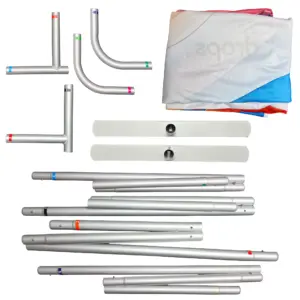
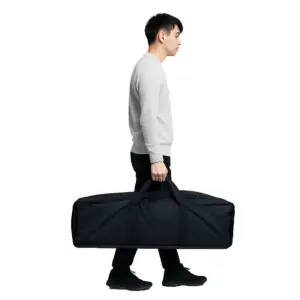
One of the defining advantages of a tension fabric backdrop is how completely it disassembles. Every tube, corner piece and base foot separates individually and packs into a carry bag. The colour-coded numbering system means reassembly is straightforward even weeks after the last use.
The carry bag is an important but often overlooked component of the system. A poor quality carry bag, typically a thin single-layer oxford fabric construction, will tear at the handles or seams after repeated use, leaving you with loose frame pieces and no reliable way to transport them. drops.sg uses a double-oxford layered carry bag for improved durability and resistance to wear across repeated transport. When evaluating any tension fabric backdrop system, check the carry bag construction. It is one of the clearest indicators of overall product quality and will matter most when you need it at an event.
For buyers who regularly transport their backdrop to multiple venues, drops.sg also offers a heavy duty trolley bag upgrade. The trolley bag allows you to wheel the entire system rather than carry it, which is particularly useful for bigger sized backdrops when navigating Singapore’s exhibition venues, hotel loading bays and multi-level event spaces.
Beyond the core frame and fabric, tension fabric backdrop systems can be configured with a range of accessories that extend their functionality:
Not all suppliers offer or stock these accessories. If your event requires any of these configurations, contact us and we will work with you to find the right setup.
Tension fabric backdrop graphics are printed on stretch polyester fabric. Polyester is the industry standard material because it is lightweight, stretchable, washable and holds dye-sublimation ink exceptionally well.
Fabric weight is measured in GSM (grams per square metre). The market standard typically ranges from 230gsm to 260gsm, with 300gsm available for specialist blockout applications. drops.sg uses 240-250gsm fabric, a weight that balances good print quality, sufficient opacity for most event applications, and enough stretch to fit cleanly over the frame without excessive resistance.
Heavier fabrics above 260gsm are harder to stretch over the frame, which makes fitting more physically demanding and can stress the frame connectors. At 300gsm, the fabric weight can also cause the frame to sag slightly on standard aluminium frames, particularly on larger sizes. This is why 300gsm is typically reserved for blockout-specific applications rather than general use.
The polyester surface has a slight semi-gloss finish inherent to the material. It is noticeably less reflective than PVC canvas but not a fully matte surface. Under event lighting, this finish is generally flattering and does not cause the glare issues associated with PVC.
Tension fabric backdrops from drops.sg include a blockout layer as standard. This is a separate backing layer stitched internally within the pillowcase fabric pocket, and it addresses two issues that standard fabric alone cannot:
1. Direct or backlit lighting
This is a problem almost nobody tells buyers about, yet it is one of the most common issues that many neglect. In venues with strong overhead lighting, near windows, or even with window grille shadows falling across the display, the support frame structure behind the fabric becomes visible as shadows through the material. This is particularly noticeable with the centre support bar on larger backdrops. Once you notice it, it is hard to ignore. The blockout layer eliminates this issue entirely by preventing light from passing through.
2. Double-sided printing
Without a blockout layer on a double-sided print, the graphic on the reverse side may bleed through slightly and be visible from the front. This reduces visual clarity and is especially problematic for designs with fine text or detailed logos. The blockout layer between the two printed sides prevents this bleed-through entirely.
Adding a blockout layer does not significantly affect how the fabric stretches over the frame. While many suppliers charge extra for this upgrade, drops.sg includes it as standard with every tension fabric backdrop order.
Single-sided printing is the default and most common choice. In the majority of event setups, the back of the backdrop is not visible. It faces a wall, a stage curtain or a booth structure. Single-sided printing is the more cost-efficient option for these scenarios.
Double-sided printing is necessary when the backdrop is freestanding in an open space where both sides are visible. For example, a standalone display in the middle of an exhibition floor, or a backdrop used as a divider between two event zones.
If you are ordering double-sided, always pair it with a blockout layer. Without it, each side’s print will be partially visible from the other side, compromising the quality of both.
All tension fabric backdrop graphics are produced using dye sublimation printing. Understanding how this process works helps explain why the print quality is superior to alternatives like screen printing or direct inkjet on fabric.
In dye sublimation, heat converts solid ink into a gas, which then bonds permanently into the polyester fabric fibres themselves. The ink does not sit on top of the fabric surface. It becomes part of the fabric. This means the print cannot peel, crack or scratch off regardless of how many times the fabric is folded, stretched, washed or handled.
The result is vibrant, full-colour graphics with sharp detail and excellent fade resistance. Full CMYK colour printing is standard. Complex artwork, photography and multi-colour designs carry no additional cost compared to simpler designs.
Both sides of a double-sided fabric can carry entirely different graphics, as each side is printed independently before the layers are assembled.
Dye sublimation on polyester produces excellent colour reproduction, but buyers should understand one important limitation: what you see on screen will not be a perfect match to the printed output. This is true across all printing methods and all suppliers. Anyone claiming 100% screen-accurate colour matching is overstating their capability.
Colour output depends on the printer’s machine calibration, ink formulation and the fabric’s natural base colour. To get as close as possible to your intended colours:
Getting your artwork right before submission saves time, avoids reprints and ensures the final display looks as intended. These are the most common mistakes to avoid:
Keep critical elements away from the edges
Always leave a safe zone around the edges of your artwork. Slight shifts during fabric production or stretching over the frame can cause edge elements to appear cut off or cramped once the fabric is taut. The exact safe zone varies by printer, but as a general rule keep all logos, text and critical content well inset from the boundary. When in doubt, ask your supplier for a print template with safe zone guidelines marked before you start designing.
Design with human placement in mind
For media walls, step-and-repeat backdrops and any display where people will stand in front, consider where subjects will be positioned in the frame. Logos and text placed at chest or shoulder height will be obscured by anyone standing in front of the backdrop. Position critical branding elements either above head height or low enough to remain visible below the subjects. This is especially relevant for press events, corporate photo opportunities and esports media walls where multiple people may be in frame simultaneously.
Always provide high resolution files
Large format printing exposes low resolution artwork immediately. A file that looks sharp on screen at 72 PPI will print visibly blurry and pixelated on a backdrop. Always provide files at a minimum of 150 PPI at print size, with 300 PPI being the recommended standard for the best output quality. The difference is clearly visible on a large format print, particularly on fine text, logos and photographic elements.
Provide vectored or flat-layered files
Submit artwork as vector files (AI, EPS, PDF) or fully flattened high resolution files (PSD, PNG) with fonts outlined and images embedded. Files with live text, unresolved layers or missing linked images can cause production errors that delay your order. Also ensure your artwork is prepared in CMYK colour mode rather than RGB. RGB is a screen colour space and will produce unpredictable colour shifts when converted to print.
Tension fabric backdrop graphics are machine washable, which is one of their practical advantages over PVC alternatives. Follow these guidelines to maintain print quality and fabric condition over multiple events:
The same principles that apply to any polyester garment apply here. Treat it accordingly and the fabric will hold up well across many events.
Tension fabric backdrops use a pillowcase construction. The fabric is designed as a large sleeve that slides over the assembled frame and zips closed. This is what creates the taut, seamless finish.
The most common installation mistake, even at professional events, is failing to pull the fabric fully below the bottom horizontal bar before zipping. The fabric must be pulled down so that the bottom edge sits below the lowest horizontal tube, and the zip must close over and around that bottom bar. If the fabric is zipped above the bottom bar, the lower portion of the graphic will sag, creating an uneven finish that is immediately visible in photos and on camera.
Take the time to check all four sides after fitting. The fabric should feel evenly tensioned across the entire surface with no loose areas or visible sag.
Tension fabric is designed to achieve a wrinkle-free finish when properly installed and cared for. In practice, some creasing after storage or transit is normal. Fabric that has been folded in a carry bag will have fold lines when first removed. This is true across the entire industry regardless of supplier or fabric weight.
Once stretched over the frame, minor creases typically self-resolve as the fabric settles under tension. For deeper creases or a particularly clean presentation, a portable steamer applied before installation will restore a smooth, professional finish. We recommend keeping a portable steamer as part of your standard event kit.
Before your event, take a few minutes to inspect your backdrop system:
Identifying any issues before your event gives you time to resolve them. Discovering a missing zipper on event day does not.
There is no industry standard for fabric storage. Folding is perfectly acceptable and is how most suppliers pack fabric for transit. The fabric does not need to be stored flat or rolled to maintain its condition.
Store the disassembled frame and fabric in a cool, dry location away from direct heat sources and out of direct sunlight. Polyester is sensitive to sustained heat exposure, which can cause fibres to degrade and colours to fade over time. Singapore’s humidity is also worth factoring in. Prolonged moisture exposure can affect the frame finish, particularly on uncoated frames. A coated frame stored in a closed carry bag handles Singapore’s climate well.
If the fabric has been washed before storage, ensure it is fully dry before packing. Storing damp fabric in a sealed bag risks mildew, which will permanently damage the print.
A tension fabric backdrop is a deceptively simple product. It looks straightforward but the quality of the components, the configuration choices and the care taken during setup all directly affect the final result. Knowing what gsm means, why rounded corners tension better, when to add a blockout layer, and how to fit the fabric correctly gives you a significant advantage over buyers who treat it as a commodity purchase.
drops.sg supplies tension fabric backdrop systems with transparent, all-in pricing. Frame, fabric print and delivery included. If you are unsure which configuration is right for your event, contact us and we will recommend the appropriate setup based on your specific requirements.
Not sure which size to order? Our tension fabric backdrop size guide for Singapore events walks you through every standard size and what each is best suited for.